Blog

Blog

The Truce Is Over: The U.S. and Iran Have Clashed Again, and the Oil Market Is Facing a Sharp Spike

share

fb-icon tweet-icon
Apme Fx | The Truce Is Over: The U.S. and Iran Have Clashed Again, and the Oil Market Is Facing a Sharp Spike

The temporary agreement between the U.S. and Iran has reached a virtual breaking point following the latest escalation. On July 8, 2026, during the NATO summit in Ankara, U.S. President Donald Trump declared that, in his view, the truce with Iran was over, though he also acknowledged that U.S. negotiators could continue talks. The statement came after the U.S. launched new strikes on Iranian targets in the Strait of Hormuz and revoked the temporary sanctions waiver that had allowed Iran to export oil. The oil market reacted with a sharp rise in prices.


Trump declared the deal with Iran over


A key political moment was Trump’s speech ahead of the NATO summit in Ankara. When asked whether the memorandum of understanding with Iran was still in effect, Trump replied that, in his view, it was over and that he no longer wished to negotiate with Tehran. The president thus declared the ceasefire over upon his arrival at the NATO summit, with his remarks following U.S. strikes in the vicinity of the Strait of Hormuz. The agreement, signed on June 17, was intended to be a transitional step toward a more permanent peace framework following the war that began on February 28 with U.S.-Israeli airstrikes on Iran. The latest attacks therefore not only impacted the current security situation but also undermined the chance of transforming the temporary ceasefire into a more stable agreement.

The U.S. struck back following attacks on tankers in the Strait of Hormuz

The U.S. military response came after attacks on three tankers in the Strait of Hormuz, one of the world’s most critical energy routes. The U.S. struck Iranian targets in response to the attacks on shipping, and U.S. Central Command announced that among the targets struck were more than 60 small boats used by Iran’s Revolutionary Guards. According to a U.S. official, the strikes also targeted air defense systems, coastal surveillance systems, surface-to-air missiles, anti-ship missiles, and drone launch sites. At the same time, they struck more than 80 Iranian targets in the vicinity of the Strait of Hormuz. These figures indicate that Washington did not focus solely on a symbolic response, but rather on a more extensive weakening of Iranian capabilities that could threaten maritime traffic.

Iran responded with attacks on U.S. sites in Bahrain and Kuwait

Following the U.S. strikes, Iran announced that its Revolutionary Guards had struck U.S. military sites in Bahrain and Kuwait. Iran also claimed to have shot down a U.S. MQ-9 drone that was allegedly interfering with the operation. This aspect of the escalation is particularly significant because it has extended the conflict to the broader Persian Gulf region, where significant U.S. military capabilities are located and where any deterioration in security immediately heightens tensions in energy markets. Iran also accused Washington of violating the ceasefire and linked the latest U.S. actions not only to military strikes but also to renewed pressure on Iranian oil exports. No civilian casualties were reported in Iran following the U.S. strikes. [2]

Oil Prices Spiked Following the Resurgence of Security Risks

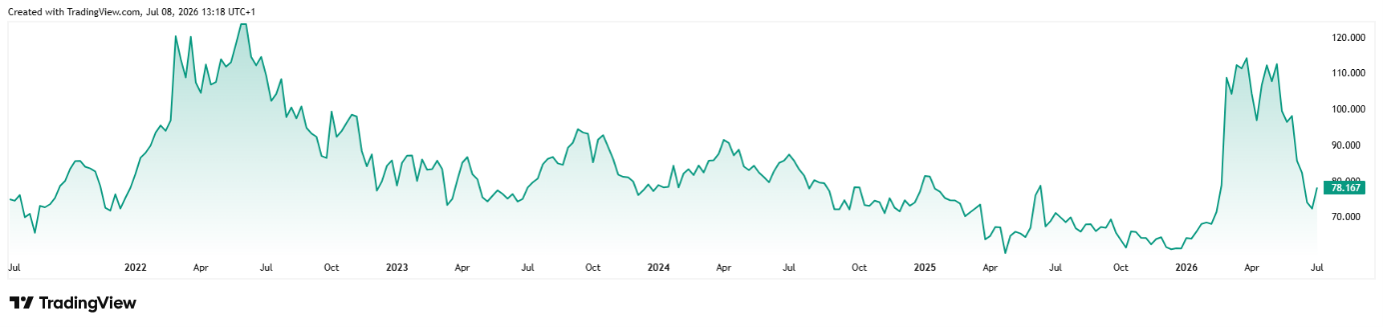
The oil market reacted immediately to the escalation. The price of Brent crude jumped by more than 4% to $79 per barrel, marking the sharpest daily increase since late May.* The reason was not just Donald Trump’s statement alone, but a broader combination of attacks on tankers, U.S. strikes, Iranian retaliation, and concerns about security in the Strait of Hormuz. According to shipping data, at least four oil and gas tankers turned back instead of attempting to pass through the strait. At the same time, the U.S. revoked a license issued by the U.S. Treasury Department on June 22 that had allowed the sale of Iranian oil, petrochemicals, and petroleum products until August 21. Following its revocation, Iran was given until July 17 to complete its transactions, which further increased uncertainty regarding the availability of Iranian oil on the market. [3]
Obrázok25

Brent crude oil price trends over the past five years*


[1,2,3] Forward-looking statements are based on assumptions and current expectations, which may be inaccurate, or on the current economic environment, which is subject to change. Such statements do not guarantee future results. They involve risks and other uncertainties that are difficult to predict. Actual results may differ materially from those expressed or implied in any forward-looking statements.

* Past performance is no guarantee of future results.


Sources:

https://www.reuters.com/world/middle-east/iran-targets-sites-bahrain-kuwait-after-wave-us-strikes-2026-07-08/

https://www.theguardian.com/world/2026/jul/08/trump-declares-ceasefire-iran-over-broadside-nato-summit

Disclaimer:

The material herein is considered as marketing communication under the relevant laws and regulations, and as such is not a subject to any prohibition on dealing ahead of the dissemination of investment research. It has not been prepared in accordance with legal requirements designed to promote the independence of investment research and should not be construed as containing investment advice, or an investment recommendation, or an offer of or solicitation for any transactions in financial instruments. The published content is intended for educational/informational purposes only. It does not take into account readers’ financial situation, personal experience or investment objectives. APME FX Trading Europe Ltd makes no representation that the information provided is accurate, current or complete; and therefore, assumes no liability for any losses arising from investments based on the supplied content. The past performance is not a guarantee of future results.

Blog

Micron as the Driving Force Behind the AI Boom: Record Profits, a Memory Crisis, and a New Market Supercycle

Micron Technology took center stage among investors and analysts in the most recent fiscal quarter, becoming one of the most prominent symbol...

Blog

ABB and Siemens are capitalizing on the data center boom.

There are still companies in Europe that can easily compete with Chinese and American corporations. They are even able to leverage the AI phenomenon and build thei...

Blog

The future of the Czech energy sector is uncertain.

For many decades, we were accustomed to the Czech Republic being self-sufficient in electricity, or rather, a net exporter. But reality is changing, and in the foresee...

🍪 Cookies

We use cookies to store, access and process personal data to give you the best online experience. By clicking Accept Cookies you consent to storing all cookies and ensure best website performance. You can modify cookie preferences or withdraw consent by clicking Cookie Settings. To find out more about cookies and purposes, read our Cookie Policy and Privacy Notice.

Cookies settings


Cookie Control

What are cookies?

Cookies are small text files that enable us, and our service provides to uniquely identify your browser or device. Cookies normally work by assigning a unique number to your device and are stored on your browser by the websites that you visit as well as third-party service providers for those website. By the term cookies other technologies as SDKs, pixels and local storage are to be considered.


If Enabled

We may recognize you as a customer which enables customized services, content and advertising, services effectiveness and device recognition for enhanced security
We may improve your experience based on your previous session
We can keep track of your preferences and personalize services
We can improve the performance of Website.


If Disabled

We won't be able to remember your previous sessions, that won't allow us to tailor the website according to your preferences
Some features might not be available and user experience reduced without cookies


Strictly necessary means that essential functions of the Website can not be provided without using them. Because these cookies are essential for the properly working and secure of Website features and services, you cannot opt-out of using these technologies. You can still block them within your browser, but it might cause the disfunction of basic website features.

  • Setting privacy preferences
  • Secure log in
  • Secure connection during the usage of services
  • Filling forms

Analytics and performance tracking technologies to analyze how you use the Website.

  • Most viewed pages
  • Interaction with content
  • Error analysis
  • Testing and Measuring various design effectivity

The Website may use third-party advertising and marketing technologies.

  • Promote our services on other platforms and websites
  • Measure the effectiveness of our campaigns

CFDs are complex instruments and carry a high risk of losing money quickly due to leverage, 81.54% of retail investors' accounts are lost when trading CFDs with this provider. You should consider whether you understand how CFDs work and whether you can afford to take the high risk of losing money. Please read the Risk Warning.