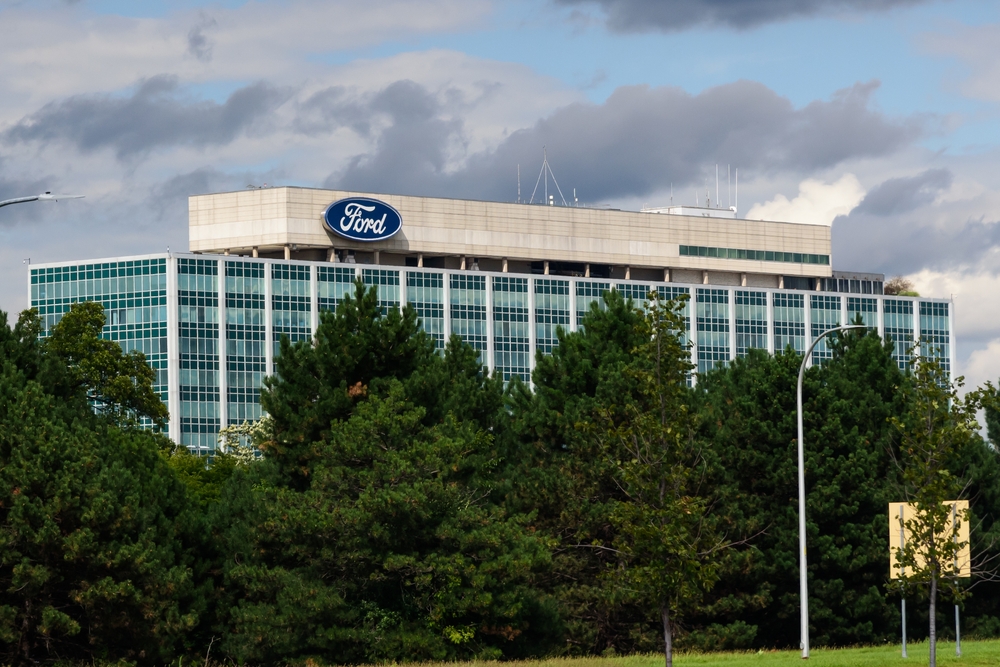
The net loss was primarily driven by extraordinary costs
Ford’s net loss of $1.3 billion was significantly impacted by extraordinary pre-tax charges totaling $4.2 billion. The largest item was a largely non-cash charge of $3.6 billion associated with the termination of the BlueOval SK joint venture, which Ford had established with the South Korean company SK On to manufacture batteries. Another $500 million was related to canceled electric vehicle programs announced in December 2025. Total revenue fell by $1.9 billion year-over-year, and the number of vehicles delivered wholesale decreased by 12%, from 1.185 million to 1.039 million units. This was due to the discontinuation of certain models, an aluminum shortage, and the scaling back of first-generation electric vehicle production in line with actual customer demand. Despite lower sales volume, adjusted operating profit increased by $400 million to $2.5 billion, and the adjusted margin improved from 4.3% to 5.2%. Operating cash flow reached $4.3 billion, and adjusted free cash flow amounted to $2.1 billion. At the end of the quarter, Ford had $22.3 billion in cash and total liquidity of $43.4 billion, providing it with sufficient resources to continue investing and pay its regular quarterly dividend of 15 cents per share.
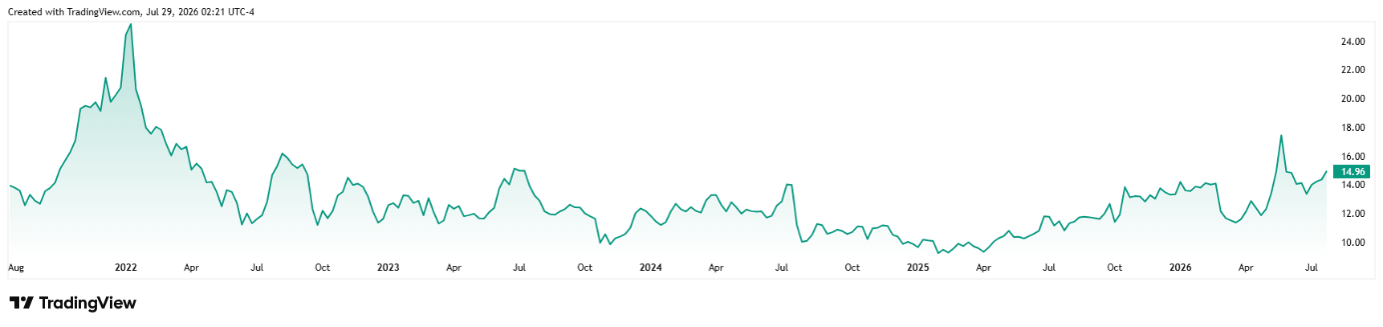
Ford Motor’s stock price performance over the past five years*
Higher-priced pickups and SUVs boosted Ford Blue’s results
The Ford Blue division, which includes internal combustion engine vehicles and hybrid models, recorded the strongest year-over-year growth. Although its wholesale deliveries fell by 8% to 639,000 vehicles, revenue rose by 1% to $26.1 billion. The division’s operating profit rose from $661 million to $1.135 billion, representing growth of approximately 72%. The margin improved from 2.6% to 4.4% as Ford sold a higher proportion of more expensive and more profitable versions and maintained its pricing power despite the lower number of vehicles delivered. The company reported that it achieved the highest revenue share in the U.S. pickup truck segment, and SUVs accounted for nearly a quarter of all Ford sales in the U.S. Ford Pro, the commercial division, posted weaker results, with revenue falling 5% to $17.8 billion and operating profit declining by $600 million to $1.718 billion. The main reason was temporary restrictions on aluminum supplies from Novelis, which disrupted the production of commercial vehicles and pickups. Ford Credit also remains a significant source of profit. The Financial Services division posted pre-tax income of $757 million, which was $112 million more than in the same period of the previous year.
The electric vehicle division lost 92 cents for every dollar of revenue
The results of the Ford Model e division highlight the extent of the challenges the automaker faces with electric vehicles. The division delivered only 28,000 vehicles to wholesale customers, representing a 53% year-over-year decline. Its revenue fell by 56%, from $2.4 billion to $1 billion. The operating loss reached $919 million, meaning that for every dollar of revenue, there was approximately 92 cents in operating loss. In absolute terms, the result was better than the $1.329 billion loss from the previous year, but the sharp drop in revenue caused the negative margin to worsen from 56.4% to 89.6%. For the first half of the year, Ford Model e generated $2.3 billion in revenue and an operating loss of $1.696 billion, with 62,000 vehicles delivered. Nevertheless, Ford has slightly improved its full-year outlook and now expects a loss of approximately $4 billion, down from the previous loss range of $4 to $4.5 billion. This figure already includes approximately $1 billion in additional investments in a new universal platform for electric vehicles and the Ford Energy business. Most of these investments are expected to take place during the second half of the year, so the electric vehicle division will continue to significantly erode the profits generated by traditional vehicles and commercial services. [2]
Higher outlook depends on prices, production, and new EV strategy
Ford has raised its full-year outlook for adjusted earnings before interest and taxes from the original range of $8.5 billion to $10.5 billion to $10 billion to $11 billion. This marks the second upward revision to the forecast in 2026. The company expects to benefit from stronger pricing, lower costs, and a resumption of production following aluminum supply issues. Supplier Novelis resumed production at its plant in New York State in June. This plant supplies aluminum used in the production of the F-150 model. However, the outage has already impacted Ford’s results, and the company’s U.S. sales fell by 9.6% in the first half of the year. Ford also continues to anticipate net costs related to tariffs of close to $1 billion, although management expects a slightly lower amount than originally projected. The automaker is not abandoning its electric vehicle plans, even after a 57.4% drop in EV sales in the U.S. during the first half of the year. In 2027, it plans to begin producing an electric pickup truck in Kentucky with a projected price of approximately $30,000. Abroad, however, it will collaborate more extensively with partners. Ford is expanding its partnership with Renault and has formed a joint venture with the Chinese company Geely, which is set to produce two electric SUV models at Ford’s plant in Valencia starting in 2028. This new approach suggests that Ford intends to pursue electrification with lower standalone costs and greater use of shared platforms, production capacity, and technologies. [3]
[1,2,3] Forward-looking statements are based on assumptions and current expectations, which may be inaccurate, or on the current economic environment, which is subject to change. Such statements do not guarantee future results. They involve risks and other uncertainties that are difficult to predict. Actual results may differ materially from those expressed or implied in any forward-looking statements.
* Past performance is no guarantee of future results.
Sources: