
The 11.7 trillion-yen intervention resulted in only a temporary strengthening of the currency
Between April 28 and May 27, 2026, the Japanese Ministry of Finance conducted foreign exchange operations totaling 11.7349 trillion yen, which amounted to approximately $72 billion during that period. Tokyo sold part of its dollar reserves and bought yen after the exchange rate exceeded 160 yen per dollar. The intervention temporarily boosted the value of the yen, but its effect had faded by the end of June. On June 30, the exchange rate exceeded 162 yen per dollar, and three weeks later it reached 163.01.* The market thus demonstrated that even a record volume of purchases may not alter the currency’s long-term trend as long as the causes of its weakening remain in place. Japanese authorities have therefore begun to hint less openly at the specific possibility of intervention and are trying to keep investors in the dark about its timing. Analysts are monitoring the range of 163 to 165 yen per dollar, but the Japanese government has not publicly set a threshold at which it will automatically intervene. The speed of movement and the level of volatility, not just the exchange rate itself, may be decisive. On July 22, Finance Minister Satsuki Katayama confirmed the government’s readiness to take decisive measures, but previous public warnings failed to halt the yen’s decline.
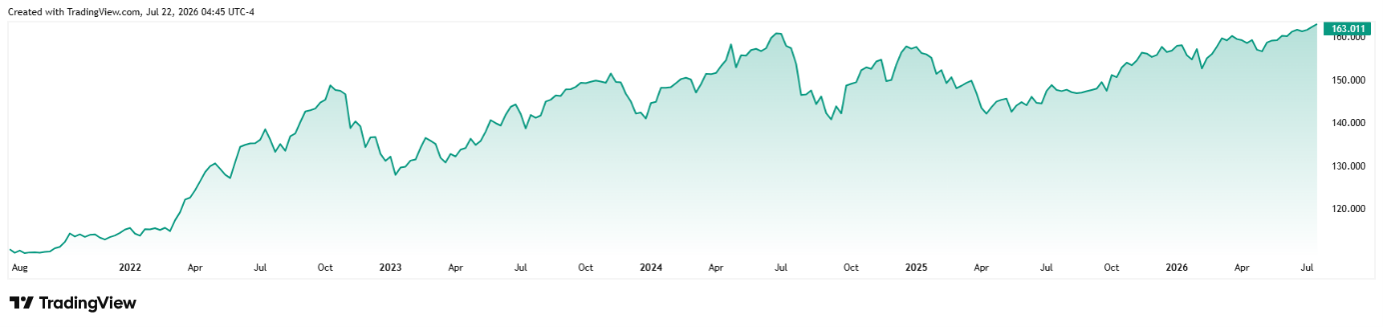
USD/JPY Price Trends Over the Last Five Years*
High oil prices and a weak yen pushed the value of imports to a record 11.3 trillion yen
The value of Japanese imports rose 25.4% year-over-year in June to a record 11.3 trillion yen. The growth was significantly higher than the market’s expected 21% and represented the fastest pace since November 2022. Crude oil was the main driver. The physical volume of imported crude oil fell by 13.7% year-over-year, but its value rose by 59.3% as the price per unit in yen reached a record high. The final price reflected both the rise in global oil prices and the weakening of the Japanese currency. At an exchange rate of 163 yen, every dollar paid for energy costs a Japanese importer approximately 16% more than at the rate of 140 yen that prevailed in the market a year ago. Exports rose by 19.3% in June, mainly due to the weaker yen and demand related to data centers and artificial intelligence. Exports to the United States rose by 13%, with sales of hybrid vehicles playing a key role. However, the growth in exports was not enough to offset the higher cost of imports, and Japan recorded a trade deficit of 406.9 billion yen. The market had expected a deficit of only 120 billion yen. The weak yen thus boosts exporters’ revenues when foreign sales are converted into domestic currency, but at the same time makes energy, food, raw materials, and other imported goods more expensive for both businesses and households.
The Bank of Japan must choose between supporting the yen and protecting economic growth
On June 16, the Bank of Japan raised its main short-term interest rate to 1%, the highest level in 31 years. The decision was adopted by a vote of seven to one, and the new rate took effect on June 17. However, even this increase failed to stabilize the yen, as Japanese rates remain significantly lower than the yields on comparable U.S. assets. Investors can therefore earn a higher return by holding dollars, which supports demand for the U.S. currency. At the same time, the Bank of Japan is facing rising price pressures. Consumer prices rose 1.5% year-over-year in May, and the index excluding fresh food increased by 1.4%. However, producer prices jumped 7.1% in June, the fastest pace since March 2023. Higher prices for energy, raw materials, and imported components may eventually feed through to consumer prices. Another rate hike could support the yen and curb imported inflation, but it would also make borrowing more expensive for businesses, households, and the government. Leaving rates unchanged would protect economic activity but could prolong the currency’s decline. Most analysts surveyed by Reuters expect the rate to rise to 1.25% by the end of the year, while it is generally expected to remain at 1% at the July 30–31 meeting. [2]
Further intervention may increase volatility, but it will not, on its own, resolve the causes of the weak yen
Japan has sufficient foreign exchange reserves for further intervention, but experience from April and May shows that intervention without changes in monetary and economic conditions yields mainly short-term effects. HSBC analysts expect the USD/JPY exchange rate to trade primarily within a range of 160 to 165 yen per dollar. The lower end of the range may be supported by occasional intervention, while the upper end may be supported by low real interest rates in Japan. According to them, a more sustained strengthening of the yen would require multiple rate hikes by the Bank of Japan, a return by the U.S. Federal Reserve to cutting rates, or an improvement in investor confidence in Japan’s public finances. For financial markets, therefore, not only the exchange rate itself but also U.S. bond yields, oil prices, and the Japanese government’s communication ahead of the central bank’s meeting will be important. A sharp appreciation of the yen following intervention could temporarily reduce the value of Japanese exporters’ foreign revenues and increase pressure on investors who borrow cheaper yen to purchase higher-yielding foreign assets. Conversely, continued depreciation would raise importers’ costs and increase the risk of further price increases. The yen’s performance has thus become a direct factor affecting the trade balance, inflation, central bank decision-making, and the earnings of major Japanese companies. The 165-yen-per-dollar level will be an important benchmark for investors, but intervention could occur sooner if the exchange rate begins to change too rapidly. [3]
[1,2,3] Forward-looking statements are based on assumptions and current expectations, which may be inaccurate, or on the current economic environment, which may change. Such statements do not guarantee future results. They involve risks and other uncertainties that are difficult to predict. Actual results may differ materially from those expressed or implied in any forward-looking statements.
* Past performance is no guarantee of future results.
Sources:
https://www.reuters.com/world/africa/yen-slides-past-163-raising-intervention-alert-2026-07-22/
https://www.mof.go.jp/english/policy/international_policy/reference/feio/monthly/20260529e.html
https://www.reuters.com/world/asia-pacific/tokyo-keeps-powder-dry-line-sand-yen-shifts-2026-06-30/