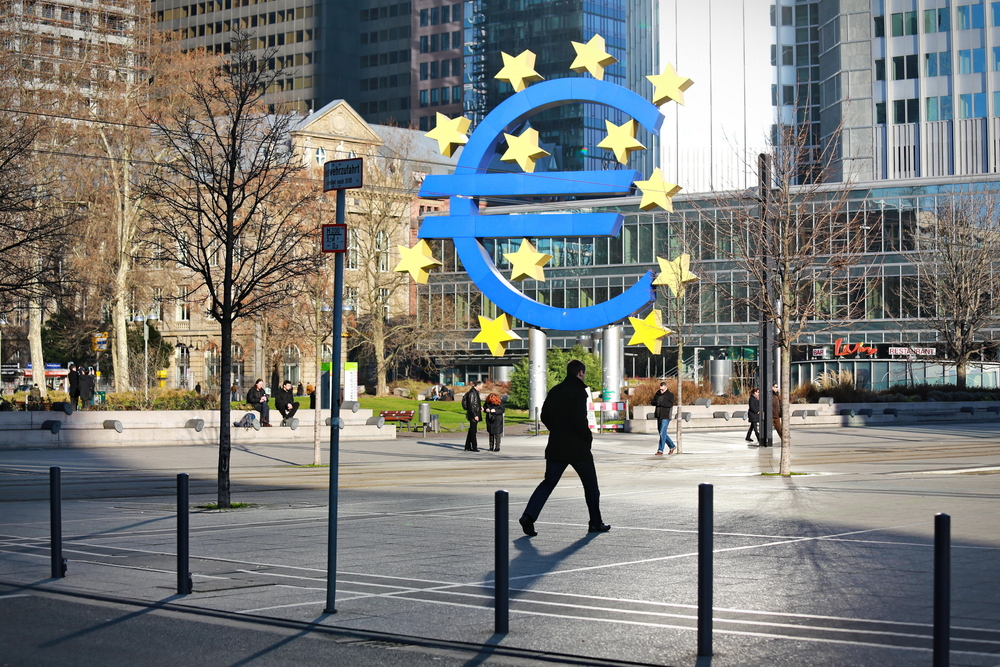
Countries using the single European currency know full well how high inflation can climb—especially the Baltic states, where inflation peaked at nearly 20 percent year-over-year in 2022. Even the eurozone average reached an unprecedented level at that time, breaking through the 8 percent threshold.
The early days of the Hormuz crisis closely resembled that shock of 2022. When the conflict between the U.S.-Israeli coalition and Iran flared up, oil prices surged sharply, much like in the first weeks of Russia’s aggression against Ukraine, and fuel prices across Europe rose significantly—though they did not reach the highs of 2022.
For now, the likelihood of inflation returning to high single-digit or double-digit levels appears low, primarily because hostilities in the Middle East have been suspended and oil prices have fallen almost back to pre-war levels. [1]
Nevertheless, the European Central Bank is far from out of the woods. In the coming weeks, it will become clearer how the recent rise in oil and energy prices will affect consumer prices, and monetary policymakers will need to closely monitor further developments in the Middle East. The region is still a long way from a lasting peace agreement between the U.S. and Iran. [2]
Sustainability of Public Finances
Rising inflation is more or less a short-term risk. The sustainability of public finances is a longer-term risk—and is becoming a serious problem for most of the eurozone’s major economies, including France, Italy, Spain, and, increasingly, Germany as well.
In terms of the government debt-to-GDP ratio, the eurozone has not yet fully recovered from the COVID-19 crisis. According to Eurostat, the average before the COVID-19 pandemic was 83.6 percent; during the pandemic, it rose to a historic high of 96.5 percent of GDP in 2020. Since then, it has been steadily declining and reached 87.8 percent in 2025.
The bloc thus appears to be on a downward trajectory, and a return of debt to pre-COVID levels may be only a matter of time. However, the picture is far from uniform. Some members have very low debt—below 50 percent of GDP, such as the Baltic states, the Netherlands, and Luxembourg—while other countries are above 100 percent, including France, Italy, Spain, and Greece. The problem is that the largest economies are also among the most indebted, which is dangerous for the eurozone as a whole: if a major economy were to run into fiscal trouble, the entire currency area would feel the impact. [3]
Germany is a special case. Its debt-to-GDP ratio remains relatively low, at around 63 percent, but Berlin is prepared to ease its fiscal policy in an effort to reignite growth—which poses another challenge for the eurozone.
Restoring Economic Growth
The third challenge is closely linked to the state of public finances. The eurozone economy has been struggling in vain to gain momentum for several years now. This is nothing new: productivity growth has been weak for a long time, even before the pandemic—as Draghi’s report aptly points out.
Since 2014, GDP growth in the eurozone has generally ranged between 1.5 percent and 2 percent annually, but has slowed to between 0.5 percent and 1.5 percent over the past three years. The economy is stagnating and lagging behind the United States. If this trend continues, the eurozone will continue to lose its share of global output, thereby weakening both its competitiveness and its weight in the global economy. [4]
Some economists and politicians argue that fiscal policy could reignite growth. The problem is that the eurozone is neither in a recession nor a crisis, and many member economies are already operating close to their potential, so the scope for fiscal policy to make a significant difference is limited. [5]
At the same time, the major economies mentioned above—France, Italy, and Spain—have very little fiscal room for further significant stimulus. Policymakers thus face an unpleasant dilemma: pursue an expansionary fiscal policy in the hope of reviving growth, or act responsibly and restore public finances to health so that they are prepared for the next crisis.
There is no easy answer, nor is there a simple formula for getting the economy to grow fast enough to close the gap with the U.S. in the foreseeable future. Either way, the eurozone is entering a difficult period—all the more so now that its former hard core is grappling with its own problems. The vision of growth comparable to that of other economic superpowers is receding ever further into the distance. [6]
[1,2,3,4,5,6] Forward-looking statements are based on assumptions and current expectations, which may be inaccurate, or on the current economic environment, which may change. Such statements do not guarantee future results. They involve risks and other uncertainties that are difficult to predict. Actual results may differ materially from those expressed or implied in any forward-looking statements.