Blog

Blog

Trump's Agreement with Iran and the Reopening of the Strait of Hormuz: Oil Prices Fall, Inflation Eases Slightly

share

fb-icon tweet-icon
Apme Fx | Trump's Agreement with Iran and the Reopening of the Strait of Hormuz: Oil Prices Fall, Inflation Eases Slightly

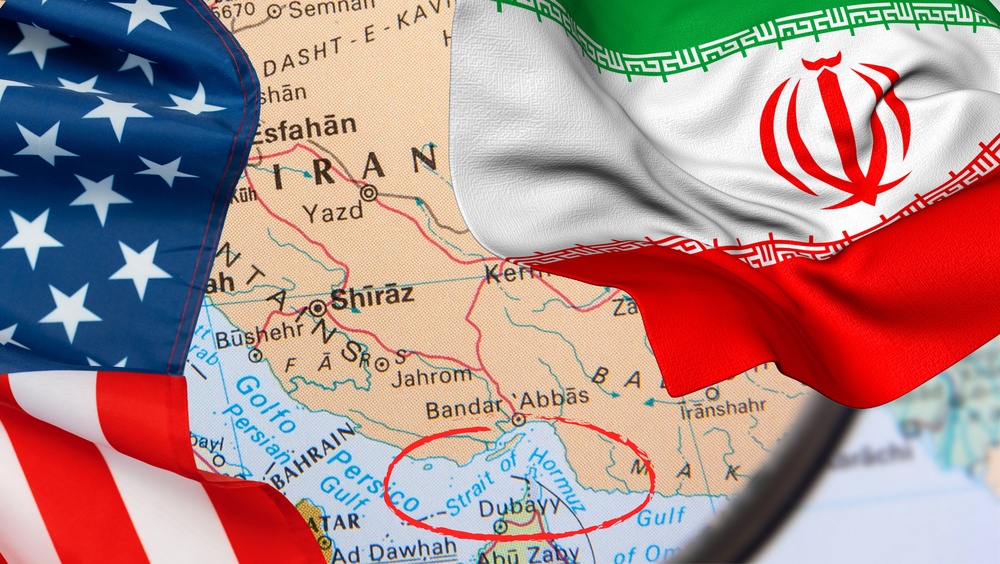
The United States and Iran have reached a preliminary agreement that brought about a ceasefire and, at the same time, the reopening of the Strait of Hormuz to shipping. Trump subsequently announced that he was ordering an end to the blockade and that ships from around the world should continue sailing, which the markets immediately interpreted as a reduction in geopolitical risk in the oil sector. For investors, it is crucial to note that this is not merely a political announcement, but an intervention in one of the world’s most important energy routes, through which a significant portion of global oil supplies passes.


The U.S.-Iran Agreement Changes Market Expectations


The United States and Iran have tentatively agreed to a ceasefire and to the reopening of the Strait of Hormuz, with Trump confirming that he is ordering an end to the blockade and the resumption of shipping through this strategic route. The final draft of the memorandum calls for the immediate reopening of the strait to commercial vessels and the end of the U.S. naval blockade of Iranian ports, with the lifting of the blockade to be completed within 30 days of signing. Another important detail is that, according to available information, this is an agreement that both sides are set to formally sign in Switzerland, which provides a clear timeframe for the entire process. This is important for the market because it reduces the risk of disruptions to oil supplies and, consequently, the geopolitical risk premium that has been reflected in energy prices in recent days.

Why the Strait of Hormuz Is Crucial

The Strait of Hormuz is crucial for the oil market because, according to available sources, approximately one-fifth of the world’s oil passes through this route. This is precisely why any signal regarding its opening or blockade is immediately reflected in oil prices, as the market factors in the risk of a potential supply disruption through the price. In the current situation, it is significant that the agreement is being reported not only by politicians but also by news agencies and media outlets, which are reporting on the actual reopening to commercial vessels and the return of shipping to normal operations. This is a crucial difference for investors, as it is not merely a diplomatic statement but a concrete change in the physical movement of oil.

Oil reacts immediately

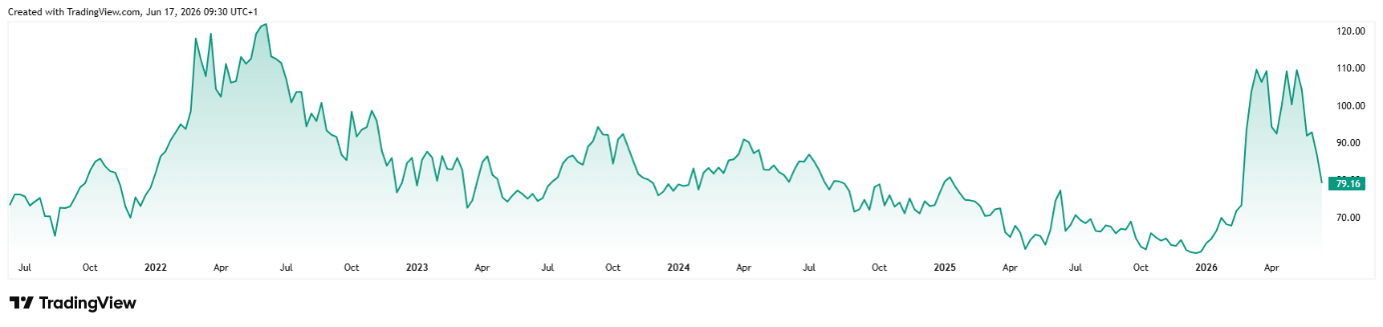
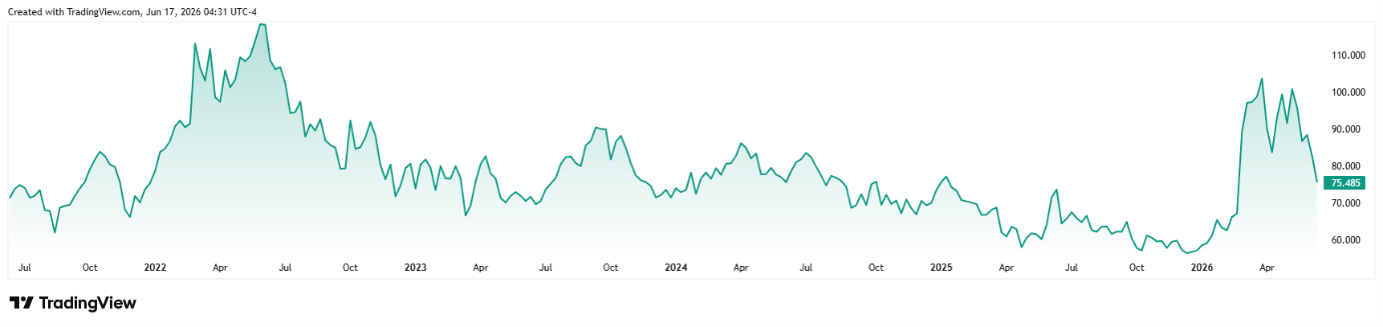
The market reacted to this news with a drop in oil prices, with Brent falling 8.70% to $79.16 per barrel since the announcement, and U.S. WTI falling 8.62% to $75.48 per barrel.* Other reports indicated that oil prices hit their lowest level since March following the announcement of the agreement, showing that the market is immediately reassessing the risk to supply. It is also significant that some reports mention the permanent opening of the strait without tolls, as well as the possibility that Iran will temporarily sell sanctioned oil as part of the agreement. If these points are confirmed, this is not just a short-term headline, but a fact that could shift the balance of supply and demand in the oil market. [1]
Obrázok22

Brent crude oil price trends over the past five years*
Obrázok21

WTI Oil Price Trends Over the Past Five Years*


What This Means for Inflation and the Markets

The decline in oil prices has a direct impact on inflation, as energy is a key input in transportation, production, and the distribution of goods and services. When oil becomes cheaper, pressure on corporate costs gradually eases, and with it, pressure on consumer prices, a development the market automatically interprets as potential relief from inflationary pressures. In this context, Reuters notes that weaker oil prices are also pushing down inflation expectations, which may affect bond yields, the dollar, and the valuation of risky assets. For stocks, this means that lower energy prices may support cost-sensitive segments of the market, while the energy sector may face weaker sentiment. [2]

* Past performance is no guarantee of future results

[1,2] Forward-looking statements are based on assumptions and current expectations, which may be inaccurate, or on the current economic environment, which may change. Such statements do not guarantee future results. They involve risks and other uncertainties that are difficult to predict. Actual results may differ materially from those expressed or implied in any forward-looking statements.


Sources:

https://www.reuters.com/business/energy/oil-slips-over-4-after-us-iran-reach-peace-deal-reopen-strait-hormuz-2026-06-14/

https://www.reuters.com/world/asia-pacific/us-iran-reach-peace-deal-signing-set-friday-pakistan-says-2026-06-14/

https://abcnews.com/Politics/trump-iran-agree-memorandum-understanding-opening-strait-hormuz/story?id=133896143

https://en.sedaily.com/international/2026/06/12/trump-signals-strait-of-hormuz-to-open-on-signing-open

Disclaimer:

The material herein is considered as marketing communication under the relevant laws and regulations, and as such is not a subject to any prohibition on dealing ahead of the dissemination of investment research. It has not been prepared in accordance with legal requirements designed to promote the independence of investment research and should not be construed as containing investment advice, or an investment recommendation, or an offer of or solicitation for any transactions in financial instruments. The published content is intended for educational/informational purposes only. It does not take into account readers’ financial situation, personal experience or investment objectives. APME FX Trading Europe Ltd makes no representation that the information provided is accurate, current or complete; and therefore, assumes no liability for any losses arising from investments based on the supplied content. The past performance is not a guarantee of future results.

Blog

Anthropic quietly filed for an IPO: The AI giant, valued at $965 billion, has overtaken OpenAI in the battle for the stock market

On May 31, 2026, a step was taken that will rewrite the historical course of the AI revolution. Anthropic, the company behind the Claude chat...

Blog

US Imposes 10% or 12.5% Tariffs on 60 Economies: Forced Labor Crackdown Reshapes Global Trade

For decades, the United States used trade policy as a tool to open markets and reduce barriers. That approach ends now. On June 2, 2026, the...

Blog

The Iran Deal Is Not the Story Yet, Oil Is.

Washington wants the market to believe that the hard part is nearly done. Tehran is signaling that it is not. That tension is where this stor...

🍪 Cookies

We use cookies to store, access and process personal data to give you the best online experience. By clicking Accept Cookies you consent to storing all cookies and ensure best website performance. You can modify cookie preferences or withdraw consent by clicking Cookie Settings. To find out more about cookies and purposes, read our Cookie Policy and Privacy Notice.

Cookies settings


Cookie Control

What are cookies?

Cookies are small text files that enable us, and our service provides to uniquely identify your browser or device. Cookies normally work by assigning a unique number to your device and are stored on your browser by the websites that you visit as well as third-party service providers for those website. By the term cookies other technologies as SDKs, pixels and local storage are to be considered.


If Enabled

We may recognize you as a customer which enables customized services, content and advertising, services effectiveness and device recognition for enhanced security
We may improve your experience based on your previous session
We can keep track of your preferences and personalize services
We can improve the performance of Website.


If Disabled

We won't be able to remember your previous sessions, that won't allow us to tailor the website according to your preferences
Some features might not be available and user experience reduced without cookies


Strictly necessary means that essential functions of the Website can not be provided without using them. Because these cookies are essential for the properly working and secure of Website features and services, you cannot opt-out of using these technologies. You can still block them within your browser, but it might cause the disfunction of basic website features.

  • Setting privacy preferences
  • Secure log in
  • Secure connection during the usage of services
  • Filling forms

Analytics and performance tracking technologies to analyze how you use the Website.

  • Most viewed pages
  • Interaction with content
  • Error analysis
  • Testing and Measuring various design effectivity

The Website may use third-party advertising and marketing technologies.

  • Promote our services on other platforms and websites
  • Measure the effectiveness of our campaigns

CFDs are complex instruments and carry a high risk of losing money quickly due to leverage, 81.54% of retail investors' accounts are lost when trading CFDs with this provider. You should consider whether you understand how CFDs work and whether you can afford to take the high risk of losing money. Please read the Risk Warning.