The close vote revealed differing views on inflation risks
The Reserve Bank of New Zealand’s Monetary Policy Committee voted four to three to keep the benchmark rate at 2.75%. Governor Anna Breman supported the pause along with three other members, while the remaining three called for a 0.25 percentage point increase to 3%. The majority wanted more time to assess the effects of the previous two rate hikes and the latest economic data. They pointed to weaker household consumption, limited wage growth, and stable medium-term inflation expectations. Proponents of an immediate hike, on the other hand, emphasized the risk that prolonged increases in the cost of energy, transportation, and other inputs would lead to sustained price growth. The bank expects year-over-year inflation to accelerate to 4.4% in the fourth quarter, primarily due to fuel prices. This outlook is based on current futures prices and remains uncertain given the volatility of energy markets. All committee members agreed that further tightening of monetary policy will likely be necessary. The main point of disagreement lies in the timing of such tightening and in the assessment of the risk that raising rates too quickly could weaken the economic recovery. [1]
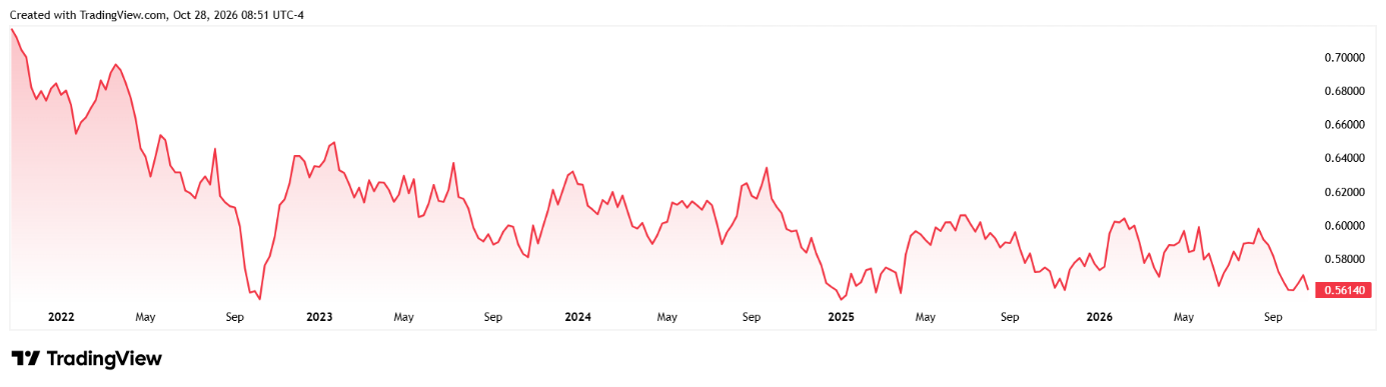
Performance of the NZD/USD currency pair over the past five years.*
The slowdown in inflation is accompanied by significant price disparities
Data from Stats NZ released on October 22 showed that consumer prices rose 3.7% year-over-year in the September quarter. Compared to the previous quarter, they rose by 0.7%. Gasoline played a significant role in the more moderate price trend, falling 6.5% quarter-over-quarter, although it remained 19.1% more expensive year-over-year. The quarterly decline was thus accompanied by a price level that remained substantially higher than a year ago. International airfares rose by 14.3% quarter-over-quarter, local taxes and fees by 6.2%, and vegetables by 10.5%. Electricity was 9.3% more expensive year-over-year. Price growth for items influenced by foreign markets reached 4.3% year-over-year, while for non-tradable items—which more closely reflect domestic conditions—it stood at 3.3%. The index excluding food, household energy, and fuel rose by 2.9%. The overall figures thus reflect both the current decline in some costs and the continuing rise in other household expenses. The slowdown in inflation therefore still means a rise in the cost of living, albeit at a slower pace.
Economic recovery remains uneven
An important factor in rate-setting decisions is the state of the New Zealand economy. According to Stats NZ data released on September 17, real gross domestic product rose by 0.2% quarter-on-quarter in the second quarter, following a 0.9% increase in the first quarter. Household consumption rose by only 0.1%, compared with a 0.6% increase in the previous quarter. Differences across sectors were significant. Construction rose by 2.7%, while transportation, postal services, and warehousing fell by 1.7%, and retail trade and accommodation each fell by 1%. Exports of goods and services rose by 3.3%, while imports fell by 0.8%. Real gross national disposable income fell by 0.4%, which signaled a weakening of the purchasing power of the country’s income. This was because import prices rose significantly faster than export prices during this period. These figures show that the improvement in overall economic performance was accompanied by weak household consumption and a decline in certain services. Therefore, when assessing the economy, the composition of growth and its pass-through to domestic demand remain crucial.
Future developments in the NZD will be influenced by the timing of future rate hikes
The October pause does not yet signal an end to rate hikes. Following the decision, Westpac economists continue to forecast a 0.25 percentage point increase in the benchmark rate to 3% in December, followed by a rise to a peak of 4% in September 2027. This is a forecast by a commercial bank, the accuracy of which depends on further data. Westpac explicitly notes that even the December hike is not certain. It considers fuel prices, inflation expectations, the pass-through of higher costs to other prices, and the evolution of global economic risks to be decisive factors. From a foreign exchange market perspective, this implies that support for the NZD will be influenced primarily by changes in the expected pace of tightening. Data reinforcing the likelihood of higher rates may help the currency, while a weaker economic outlook could lead to a reassessment of these expectations. The October decision demonstrated how significant a move can occur when a central bank acts differently than investors had anticipated. Therefore, for the NZD’s future direction, it will be important whether new information supports the expected continuation of rate hikes or a further wait-and-see approach. [2]
Warning! This marketing material is not and should not be construed as investment advice. Past performance is no guarantee of future returns. Investing in foreign currencies may affect returns due to fluctuations. All securities transactions may result in either gains or losses. Forward-looking statements represent assumptions and current expectations that may not be accurate, or are based on the current economic environment, which is subject to change. These statements do not guarantee future performance. APME FX Trading Europe Ltd. is regulated by the Cyprus Securities and Exchange Commission.
[1,2] Forward-looking statements are based on assumptions and current expectations that may be inaccurate, or on the current economic environment, which may change. Such statements are not a guarantee of future performance. They involve risks and other uncertainties that are difficult to predict. Actual results may differ materially from those expressed or implied in any forward-looking statements.
*Past performance is no guarantee of future results
Sources:
https://www.rbnz.govt.nz/news-and-events/news/2026/10/ocr-held-at-2-75-percent
https://www.westpaciq.com.au/economics/2026/10/rbnz-october-2026-monetary-policy-review
https://www.stats.govt.nz/information-releases/consumers-price-index-september-2026-quarter/
https://www.stats.govt.nz/information-releases/gross-domestic-product-june-2026-quarter/