Blog

Blog

The Real Shock from Beijing Lies in Oil, Not Trade

share

fb-icon tweet-icon
Apme Fx | The Real Shock from Beijing Lies in Oil, Not Trade

Donald Trump spent 43 hours in Beijing, arriving with a delegation of CEOs, trade promises, and dealmaker rhetoric. He left with Xi Jinping's statement that China would not supply military equipment to Iran, and a vague pledge that China might start buying American oil. No volumes, no timelines, no signed contracts. Trump concluded the summit largely where he began. For markets, however, the story does not end with diplomatic disappointment. That is precisely where it starts.


Beijing Was Never Only About Trade


The summit was always more than a trade negotiation. Iran, Taiwan, AI, nuclear weapons, and commerce were all on the table simultaneously, making it the first meeting of this scale in more than six months. Xi set the tone early, warning that any mismanagement of the Taiwan question could put the US-China relationship in great jeopardy. Beijing used the summit to push its own framework: a three-year strategic stability agreement that, from China's perspective, anchors the relationship with Washington without surrendering any concrete leverage. Analyst Jack Lee from China Macro Group described it as Beijing's attempt to use Trump's willingness to engage transactionally to build a long-term framework for the entire US-China relationship, including future administrations. That is not a trade deal. That is a different game entirely.

Hormuz Became the Real Market Story

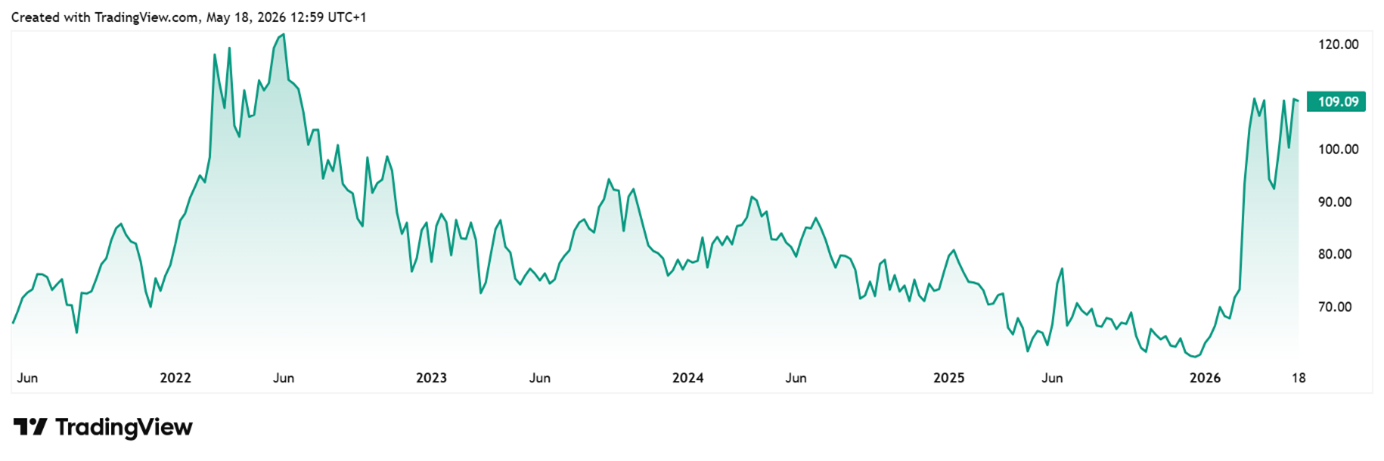
The most important market signal from the summit did not come from the press conference. It came from the oil market. Brent rose more than 2% on Friday to $108.25 per barrel after Trump told Fox News that he was losing patience with Iran and that he planned to do much more.* At the same time, Trump said during the summit that he never directly asked Xi to pressure Iran on Hormuz, because, in his own words, he does not need favors. The strait, through which roughly one-fifth of global crude exports pass, has been effectively closed since the US-Israel conflict with Iran began in February. During the summit, a Chinese tanker crossed the waterway under special conditions that Iran had negotiated for certain vessels. That is not a normalization of traffic. That is one tanker.
Obrázok17

Brent Crude Oil Price performance over the past five years*


The Gap Between Announcements and Deliverables Is Still Wide

The Chinese side described the arrangements discussed during Trump's visit on tariffs, agriculture, and aircraft as preliminary, with details to be finalized through newly established trade boards. The summit outcome was meagre, amounting to a stabilization of relations and an effort to prevent further escalation rather than any breakthrough. China purchased more than 90% of Iran's oil exports in 2024, and a large share of its broader crude imports also passes through Hormuz. That means Beijing has its own economic interest in keeping the strait open, not just a diplomatic one. But it also means China is not willing to damage its relationship with Tehran simply to do Washington a favor.

What Investors Should Watch Next

The next phase is not about the summit itself, but about whether this political channel produces real changes in energy security and trade implementation. If Washington and Beijing can use the current dialogue to lower pressure around Iran and improve confidence in shipping through Hormuz, oil could lose part of its geopolitical premium, which would matter directly for inflation expectations and indirectly for central bank thinking, bond yields, and the path of the US dollar against commodity-linked currencies. If that does not happen, the same three risks will stay tightly connected. Strategic friction between the United States and China, instability in the Middle East, and a market that still responds sharply to every update on one of the world’s most important energy chokepoints. That is the real significance of Beijing. The summit did not need to produce a historic trade agreement to matter, because its biggest consequence may be that it refocused investors on the one issue that can move multiple asset classes at once, oil supply risk.

* Past performance is no guarantee of future results


Sources:

https://www.cnbc.com/2026/05/15/trump-xi-summit-the-3-big-takeaways-from-historic-meeting-in-beijing.html

https://www.cnbc.com/2026/05/15/oil-prices-china-us-iran-strait-of-hormuz-middle-east.html

https://www.nytimes.com/2026/05/15/business/oil-stocks-gas-trump-iran.html

https://www.euronews.com/2026/05/15/underwhelming-summit-outcome-in-china-brings-trump-back-to-reality

https://www.dw.com/en/us-china-summit-exposes-trumps-limits-on-iran-war-taiwan/a-77171942

https://www.reuters.com/world/china/trump-xi-set-beijing-talks-with-trade-truce-iran-war-stake-2026-05-13/

https://www.reuters.com/world/china/china-signals-tariff-cuts-advances-farm-market-access-after-trump-xi-summit-2026-05-16/

Disclaimer:

The material herein is considered as marketing communication under the relevant laws and regulations, and as such is not a subject to any prohibition on dealing ahead of the dissemination of investment research. It has not been prepared in accordance with legal requirements designed to promote the independence of investment research and should not be construed as containing investment advice, or an investment recommendation, or an offer of or solicitation for any transactions in financial instruments. The published content is intended for educational/informational purposes only. It does not take into account readers’ financial situation, personal experience or investment objectives. APME FX Trading Europe Ltd makes no representation that the information provided is accurate, current or complete; and therefore, assumes no liability for any losses arising from investments based on the supplied content. The past performance is not a guarantee of future results.

Blog

US Imposes 10% or 12.5% Tariffs on 60 Economies: Forced Labor Crackdown Reshapes Global Trade

For decades, the United States used trade policy as a tool to open markets and reduce barriers. That approach ends now. On June 2, 2026, the...

Blog

The Iran Deal Is Not the Story Yet, Oil Is.

Washington wants the market to believe that the hard part is nearly done. Tehran is signaling that it is not. That tension is where this stor...

Blog

Inflation Is Back, Powell Is Out, and Markets Have No Clear Answer

The timing could not have been more pointed. On Tuesday, May 12, the U.S. Bureau of Labor Statistics published April's inflation figures, and...

🍪 Cookies

We use cookies to store, access and process personal data to give you the best online experience. By clicking Accept Cookies you consent to storing all cookies and ensure best website performance. You can modify cookie preferences or withdraw consent by clicking Cookie Settings. To find out more about cookies and purposes, read our Cookie Policy and Privacy Notice.

Cookies settings


Cookie Control

What are cookies?

Cookies are small text files that enable us, and our service provides to uniquely identify your browser or device. Cookies normally work by assigning a unique number to your device and are stored on your browser by the websites that you visit as well as third-party service providers for those website. By the term cookies other technologies as SDKs, pixels and local storage are to be considered.


If Enabled

We may recognize you as a customer which enables customized services, content and advertising, services effectiveness and device recognition for enhanced security
We may improve your experience based on your previous session
We can keep track of your preferences and personalize services
We can improve the performance of Website.


If Disabled

We won't be able to remember your previous sessions, that won't allow us to tailor the website according to your preferences
Some features might not be available and user experience reduced without cookies


Strictly necessary means that essential functions of the Website can not be provided without using them. Because these cookies are essential for the properly working and secure of Website features and services, you cannot opt-out of using these technologies. You can still block them within your browser, but it might cause the disfunction of basic website features.

  • Setting privacy preferences
  • Secure log in
  • Secure connection during the usage of services
  • Filling forms

Analytics and performance tracking technologies to analyze how you use the Website.

  • Most viewed pages
  • Interaction with content
  • Error analysis
  • Testing and Measuring various design effectivity

The Website may use third-party advertising and marketing technologies.

  • Promote our services on other platforms and websites
  • Measure the effectiveness of our campaigns

CFDs are complex instruments and carry a high risk of losing money quickly due to leverage, 81.54% of retail investors' accounts are lost when trading CFDs with this provider. You should consider whether you understand how CFDs work and whether you can afford to take the high risk of losing money. Please read the Risk Warning.