
Blog

Blog

Inflation Is Back, Powell Is Out, and Markets Have No Clear Answer

share

fb-icon tweet-icon
Apme Fx | Inflation Is Back, Powell Is Out, and Markets Have No Clear Answer

The timing could not have been more pointed. On Tuesday, May 12, the U.S. Bureau of Labor Statistics published April's inflation figures, and the number came in at 3.8% year-over-year, up from 3.3% in March and the highest reading since May 2023. The same afternoon, the Senate voted 51-45 to confirm Kevin Warsh as a Federal Reserve governor, immediately triggering the 30-hour procedural clock before a final vote on his appointment as Fed chair. That vote is expected today. Jerome Powell's chairmanship ends on Friday. In a single day, markets got the sharpest inflation print in three years and the clearest signal yet that the Fed's leadership is about to change hands.

Why Energy Is Running the Show

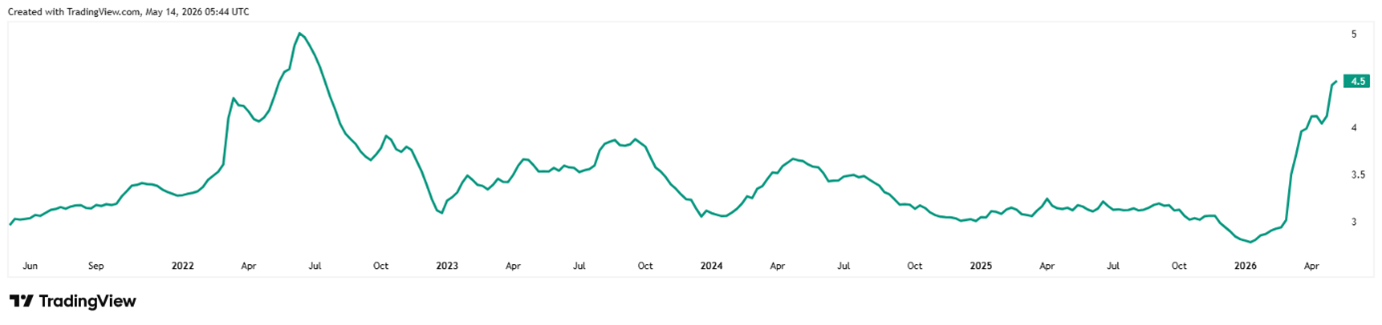
April's CPI number looks alarming at the headline level, but the breakdown tells a more specific story. Energy alone accounted for more than 40% of the entire monthly increase, with gasoline up 5% on the month and 28.4% over the past year.* The overall energy index is now 17.9% higher than a year ago, a direct consequence of the Iran conflict and the disruption to shipping through the Strait of Hormuz. Core inflation, which strips out food and energy, came in at 2.8% annually, its highest since September 2025, but still well below the headline figure. Shelter rose 0.6% on the month, food added 0.5%, and airline fares jumped 2.8% in April alone, up 20.7% over the year. The picture is not one of a broadly overheating economy. It is one where a geopolitical shock is feeding directly into consumer prices, and the Fed has limited tools to address the root cause.
Obrázok16

The general United States Gasoline Prices index performance over the past five years*

The New Fed Chair Inherits a Mess

Kevin Warsh arrives at the Fed at a moment that would test any central banker. During his Senate confirmation hearing in April, he was asked directly whether Trump had pressured him to cut rates. His answer was unambiguous: the president never once asked him to commit to any particular interest rate decision. He also told the committee that inflation is a choice and the Fed must take responsibility for it. That kind of language signals a chair who will prioritize credibility over political comfort, at least in public. But Warsh also comes with an unconventional framework. He wants to replace the Fed's current core PCE benchmark with trimmed average measures that strip out extreme price movements, including war-driven energy spikes. Under that approach, Bank of America's analysis found that current inflation would read closer to 2.3% rather than the headline 3.8%. That is not a technicality. It is a significant shift in how the Fed defines the problem it is trying to solve, and it has real consequences for when and whether rate cuts become justifiable. On top of that, Warsh has signaled plans to reduce the Fed's $6.7 trillion balance sheet closer to $3 trillion, a move that would tighten financial conditions even without touching the policy rate.

What the Rate Market Is Actually Pricing

The Fed has held rates at 3.5 to 3.75% through three consecutive meetings in 2026, and Tuesday's inflation data did nothing to change that picture in the near term. CME FedWatch is currently showing a roughly 71.5% probability that rates stay unchanged through the end of the year. A CNBC survey of 26 Fed watchers found that, on average, respondents do not expect a single cut in 2026, with only 58% expecting any reduction at all. Rob Morgan from Mosaic put it plainly: Warsh will probably face challenges in delivering the rate cuts Trump wants, as oil prices and inflation are likely to stay elevated for an extended period. The University of Michigan's latest consumer survey puts one-year inflation expectations at 4.8%, the highest in seven months, which is the kind of number that tends to make a central bank cautious, regardless of who is running it. The base case right now is no movement until at least the fourth quarter, and that is before accounting for what May and June CPI prints look like once this month's energy shock fully feeds through.

What This Means for Investors

The market has so far absorbed the April CPI number without a significant reaction, partly because the energy-driven composition makes it easier to look through. But the combination of a new Fed chair, a frozen rate cycle, and inflation running at 3.8% creates a backdrop where the range of outcomes is wider than it has been in some time. In the short term, energy equities, oil producers, and inflation-linked assets remain in a favorable position. Bonds face continued pressure if the last remaining cut expectations for this year continue to get priced out. For equities, the S&P 500 is trading at elevated multiples against a backdrop where the cost of capital is not falling, and the earnings outlook depends heavily on whether energy costs stabilize. The deeper question for investors is not what Warsh will do in his first press conference. It is whether his new inflation measurement framework, if adopted, will effectively redefine what the Fed considers acceptable, and how long it takes markets to figure out whether that is a genuine policy shift or just a different way of reading the same data.

* Past performance is no guarantee of future results


Sources:

https://www.bls.gov/news.release/cpi.nr0.htm

https://www.reuters.com/markets/us/warsh-led-feds-2-inflation-goal-might-be-different-2-2026-04-23/

https://www.cnbc.com/2026/04/22/kevin-warsh-inflation-trend-pce-trump.html

https://www.cnbc.com/2026/04/28/inflation-could-get-in-the-way-of-warshs-desire-to-cut-interest-rates-cnbc-survey-finds.html

https://www.politico.com/news/2026/04/29/warsh-fed-powell-trump-iran-inflation-00896496
Disclaimer:

The material herein is considered as marketing communication under the relevant laws and regulations, and as such is not a subject to any prohibition on dealing ahead of the dissemination of investment research. It has not been prepared in accordance with legal requirements designed to promote the independence of investment research and should not be construed as containing investment advice, or an investment recommendation, or an offer of or solicitation for any transactions in financial instruments. The published content is intended for educational/informational purposes only. It does not take into account readers’ financial situation, personal experience or investment objectives. APME FX Trading Europe Ltd makes no representation that the information provided is accurate, current or complete; and therefore, assumes no liability for any losses arising from investments based on the supplied content. The past performance is not a guarantee of future results.

Blog

Fed at a Crossroads

There was a time when the Federal Reserve's job, while never easy, followed a recognizable script. Inflation rises, the Fed tightens. Inflation f...

Blog

UAE Walks Away from OPEC: The End of an Era for Global Oil

For nearly sixty years, the United Arab Emirates stood at the center of the world’s most influential oil alliance. That era now comes to a...

Blog

Google Makes AI Agents the Core of Its Enterprise Business

Artificial intelligence is entering a new phase, and Google wants to define it. At Cloud Next on April 22, the company placed AI agents at th...

🍪 Cookies

We use cookies to store, access and process personal data to give you the best online experience. By clicking Accept Cookies you consent to storing all cookies and ensure best website performance. You can modify cookie preferences or withdraw consent by clicking Cookie Settings. To find out more about cookies and purposes, read our Cookie Policy and Privacy Notice.

Cookies settings


Cookie Control

What are cookies?

Cookies are small text files that enable us, and our service provides to uniquely identify your browser or device. Cookies normally work by assigning a unique number to your device and are stored on your browser by the websites that you visit as well as third-party service providers for those website. By the term cookies other technologies as SDKs, pixels and local storage are to be considered.


If Enabled

We may recognize you as a customer which enables customized services, content and advertising, services effectiveness and device recognition for enhanced security
We may improve your experience based on your previous session
We can keep track of your preferences and personalize services
We can improve the performance of Website.


If Disabled

We won't be able to remember your previous sessions, that won't allow us to tailor the website according to your preferences
Some features might not be available and user experience reduced without cookies


Strictly necessary means that essential functions of the Website can not be provided without using them. Because these cookies are essential for the properly working and secure of Website features and services, you cannot opt-out of using these technologies. You can still block them within your browser, but it might cause the disfunction of basic website features.

  • Setting privacy preferences
  • Secure log in
  • Secure connection during the usage of services
  • Filling forms

Analytics and performance tracking technologies to analyze how you use the Website.

  • Most viewed pages
  • Interaction with content
  • Error analysis
  • Testing and Measuring various design effectivity

The Website may use third-party advertising and marketing technologies.

  • Promote our services on other platforms and websites
  • Measure the effectiveness of our campaigns

CFDs are complex instruments and carry a high risk of losing money quickly due to leverage, 81.54% of retail investors' accounts are lost when trading CFDs with this provider. You should consider whether you understand how CFDs work and whether you can afford to take the high risk of losing money. Please read the Risk Warning.