U.S. bond yields have reached their highest levels in nearly two decades
The most significant pressure is visible at the long end of the U.S. bond market. The yield on 30-year U.S. Treasury bonds rose to 5.3371% during Tuesday’s trading, while the 10-year yield reached a high of 4.7478%, its highest level since January 2025.* The rise in yields is the result of several issues that have emerged simultaneously. Investors are grappling with high U.S. budget deficits, a growing volume of new government debt, weaker demand from some foreign investors, and inflationary risks linked to the conflict in the Middle East. Energy prices are another source of tension. Higher oil prices could increase costs for both businesses and consumers and complicate the return of inflation to the central bank’s target. Interestingly, long-term yields are rising despite a series of softer economic data from the U.S. This suggests that the issue is no longer solely related to expectations regarding the Fed’s actions. Investors are demanding higher yields as compensation for the growing debt burden and uncertainty surrounding the long-term outlook for public finances. Moreover, the pressure is not limited to the United States. Bond yields in Japan, Germany, and France have also reached multi-year or multi-decade highs, making the rising cost of capital a global issue. [1]
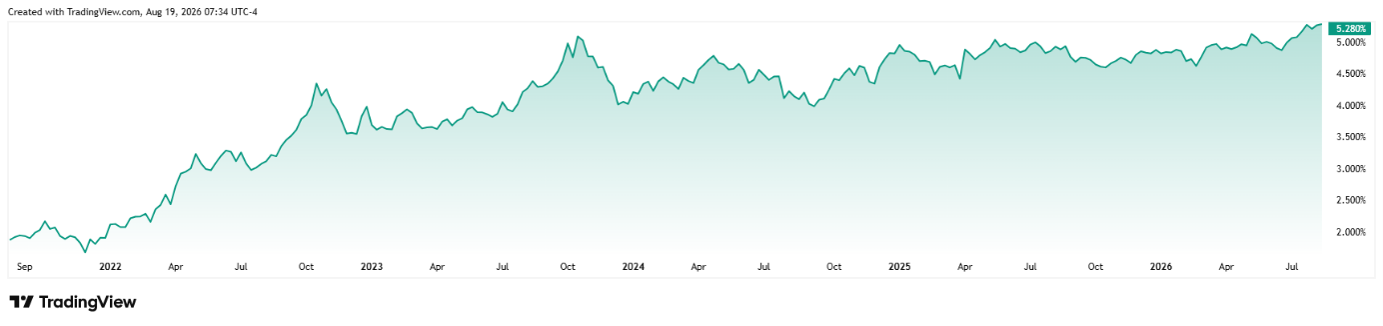
Yield on 30-year U.S. Treasury bonds over the past five years*
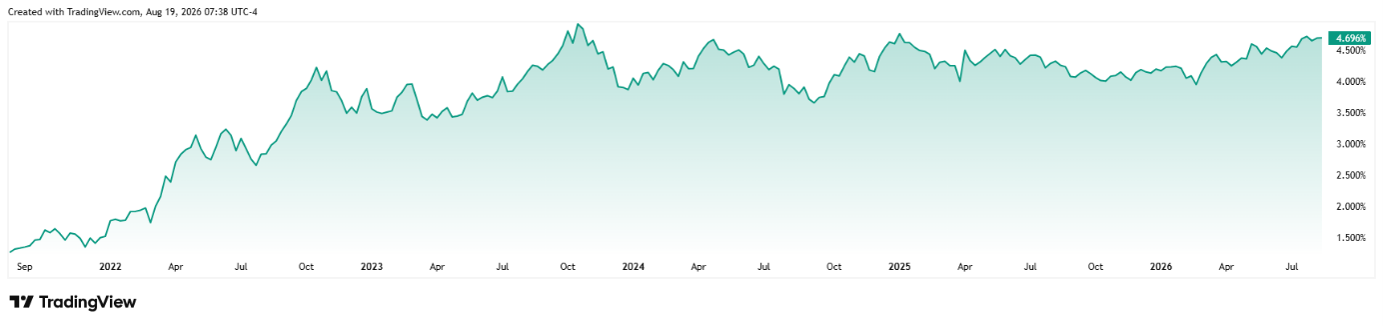
Yield on 10-year U.S. Treasury bonds over the past five years*
The AI boom is beginning to exert its own pressure on the cost of capital
An unusual aspect of the current rise in yields is that the pressure on the bond market is not coming solely from governments. Large technology companies need increasingly more debt financing to build data centers, purchase AI accelerators, develop energy infrastructure, and make other investments necessary to expand computing capacity. Alphabet, Amazon, and Meta issued nearly $220 billion in bonds during 2026, which is already more than double the $108 billion issued in all of 2025. At the same time, the need for government financing remains high. The U.S. budget deficit is expected to reach approximately $1.9 trillion this year, or about 6% of GDP. As a result, governments and the world’s largest technology companies are all competing for capital in the bond market. The result is higher yield demands from investors. This trend is even more evident in real yields, which factor in expected inflation. The real yield on 30-year U.S. Treasury bonds has reached approximately 3%, its highest level in about 18 years. For the AI sector, this is a significant change. Although the largest technology companies have strong balance sheets and high operating cash flows, the scale of planned investments is gradually changing how AI expansion is financed. The larger the portion of investments financed through the bond markets, the more important long-term interest rates will be for the economics of AI projects. [2]
Higher yields are affecting tech stocks in two ways
The bond market poses a problem for the AI rally not only through higher financing costs but also through the valuations of the stocks themselves. The yield on U.S. Treasury bonds is one of the key inputs in valuing future corporate earnings. When yields rise, future cash flows have a lower present value. This effect tends to be more pronounced for growth-oriented tech companies, as a large portion of their valuation depends on profits expected in future years. At the same time, investors are receiving more attractive yields on U.S. Treasury bonds and therefore do not have to accept equally high valuations for riskier assets. The market reaction on August 18 was significant in this regard. This movement indicates that investors did not begin to broadly exit U.S. stocks, but rather reduced their exposure primarily to segments with high growth expectations. This is important for the AI rally, as its final phase was driven not only by rising earnings but also by investors’ willingness to pay high multiples for expected future growth.
Strong AI demand remains, but the financial environment is changing
The current movement in bonds does not yet mean that the fundamental story of artificial intelligence is over. Earnings reports from Microsoft, Amazon, and other major tech companies continue to show strong demand for cloud and AI infrastructure, and the shortage of available computing capacity remains a problem. However, the environment in which this expansion is financed has changed. While the bond market partially stabilized on August 19, yields on long-term U.S. bonds remained around 5.28%, still close to levels not seen in nearly two decades.* From an investor’s perspective, this shifts the fundamental question surrounding AI. It is no longer enough to simply track the growth rate of chipmakers’ revenue or the volume of orders from data centers. The cost of capital needed to finance the entire investment cycle is also important. If large technology companies continue to make record capital expenditures while increasingly relying on bond financing, the level of long-term yields becomes one of the key factors for both the valuations and returns of AI projects. The current bond market shock therefore does not negate the growth of artificial intelligence, but it does show that even strong fundamentals may not fully protect technology stocks from a significant change in the cost of capital. [3]
[1,2,3] Forward-looking statements are based on assumptions and current expectations, which may be inaccurate, or on the current economic environment, which may change. Such statements do not guarantee future results. They involve risks and other uncertainties that are difficult to predict. Actual results may differ materially from those expressed or implied in any forward-looking statements.
* Past performance is no guarantee of future results.
Sources:
https://www.reuters.com/world/china/global-markets-wrapup-1-2026-08-18/
https://www.reuters.com/world/china/global-markets-global-markets-2026-08-19/