Record revenue confirms the strength of the core business
Adobe posted record revenue of $6.76 billion in the third quarter, representing year-over-year growth of 13% and exceeding analysts’ expectations of approximately $6.70 billion. Adjusted earnings per share came in at $6.13 compared to the expected $6.09, while net income under GAAP totaled $1.83 billion. Operating income reached $2.35 billion, and cash flow from operating activities hit a record $2.52 billion. The strength of the subscription model remains particularly important. Subscription revenue reached $6.56 billion, up 14% year-over-year. The segment targeting creative and marketing professionals generated $4.65 billion, up 13% from a year ago, while the segment targeting business professionals and consumers grew by 16% to $1.91 billion. Total annual recurring revenue thus reached $27.5 billion at the end of the quarter. Adobe also continued to return capital to shareholders, repurchasing approximately 9.5 million of its own shares during the quarter.
Artificial intelligence is already generating revenue, but it still accounts for a small portion of the total
The performance of products built primarily on artificial intelligence garnered the most attention. Their annual recurring revenue exceeded $650 million and grew by more than 150% year-over-year. Annual recurring revenue from the Firefly app and Firefly credit bundles alone increased by 40% compared to the previous quarter. Adobe is also expanding Firefly far beyond its original image-generation capabilities. During the quarter, it added music, speech, and sound effect generation and further developed tools designed to automate creative processes. Firefly Enterprise is gradually gaining traction among large companies, and Adobe cited Disney, Publicis, T-Mobile, the Premier League, and Tennis Australia among its new customers. However, this is where the main question of the current investment narrative arises. More than $650 million represents a very rapidly growing business, but compared to total annual recurring revenue of $27.5 billion, its share remains relatively low. Adobe therefore needs to demonstrate that strong AI adoption will translate to a greater extent into paid services and higher revenue. [2]
More than a billion users give Adobe room for further monetization
One of the most significant announcements of the quarter was surpassing the one-billion mark for monthly active users across Adobe’s products, with the number growing by more than 20% year-over-year. Acrobat and Express alone are now used by more than 900 million people monthly, representing growth of more than 25%, and the number of Acrobat AI Assistant users doubled in just one quarter. The free user base for creative products is also growing very rapidly. Firefly, Express, and the web and mobile versions of Photoshop, Lightroom, and Premiere have collectively surpassed 100 million monthly active users, a year-over-year increase of more than 70%. Adobe is thus strategically leveraging free AI features to expand its reach and subsequently working to migrate users to paid services. The scope of its ecosystem is a significant advantage in this regard. Through Acrobat alone, users open more than 400 billion PDF documents annually, and the company is also expanding its features to platforms such as ChatGPT, Claude, Chrome, Microsoft Edge, and WhatsApp. The challenge, therefore, is not only to acquire new users but, above all, to increase the proportion of those who will be willing to pay regularly for new AI features. [3]
The higher full-year outlook was not enough to fully convince the market
Following a strong quarter, Adobe raised its outlook for the full fiscal year 2026 and now expects revenue between $26.576 billion and $26.626 billion and adjusted earnings per share between $24.45 and $24.50. Total annual recurring revenue is expected to grow 10.2% year-over-year. However, the outlook for the fourth quarter was less convincing. The company anticipates revenue of $6.80 billion to $6.85 billion, with the midpoint of this range falling slightly short of Wall Street’s expectations of approximately $6.85 billion. Adjusted earnings per share are expected to reach $6.30 to $6.35. As a result, the stock fell by approximately 1.9% in after-hours trading following the release of the results.* Furthermore, the results come amid a major leadership change at the company. Anil Chakravarthy will become the new president and CEO on December 1, while longtime CEO Shantanu Narayen will transition to the role of executive chairman. For Adobe, the coming period will not be solely about further growth in AI adoption. Investors will want to see whether the new generation of products can accelerate revenue growth at a time when competition in creative software is intensifying, and companies like Canva and Figma are expanding their own AI tools. [4]
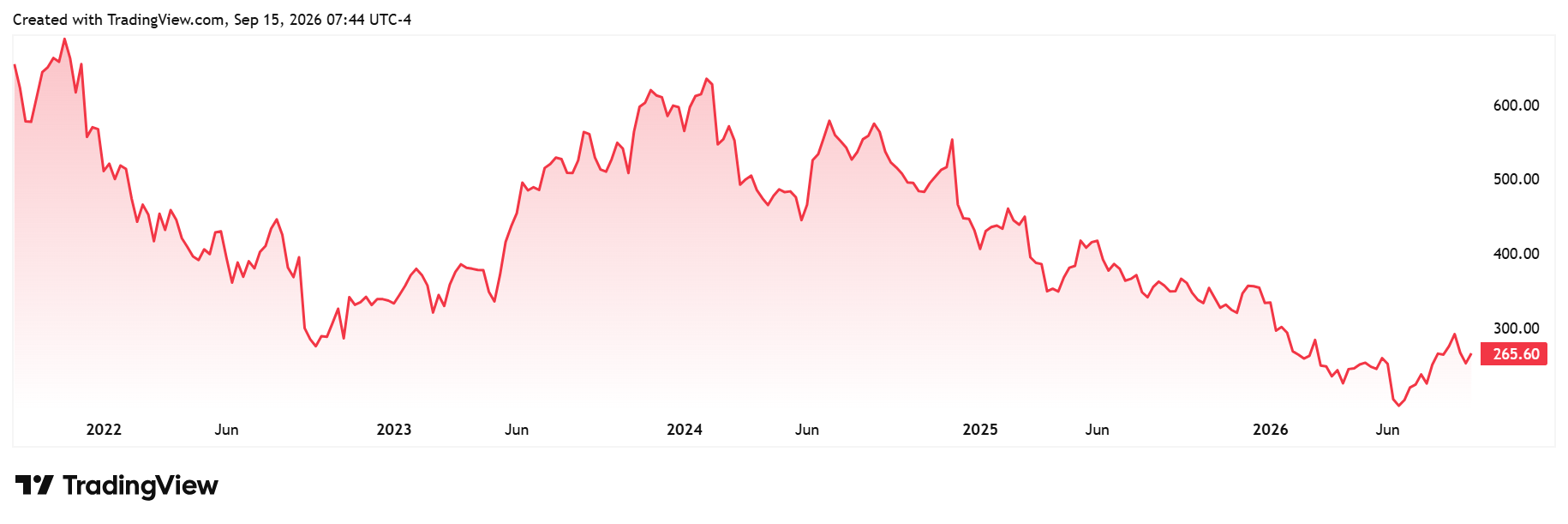
Adobe’s stock performance over the past five years*
[1,2,3,4] Forward-looking statements are based on assumptions and current expectations, which may be inaccurate, or on the current economic environment, which may change. Such statements do not guarantee future results. They involve risks and other uncertainties that are difficult to predict. Actual results may differ materially from those expressed or implied in any forward-looking statements.
* Past performance is no guarantee of future results.
Sources:
https://www.adobe.com/cc-shared/assets/investor-relations/pdfs/01906202/au56y4ter.pdf
https://www.adobe.com/cc-shared/assets/investor-relations/pdfs/01906202/c6yetrerew.pdf
https://www.reuters.com/business/adobe-beats-third-quarter-revenue-estimates-2026-09-10/